Do you consider the word "extravert" to be a compliment or an insult? My theory - and I believe I've expressed it here before - is that Canadians and Americans define this word differently. To Americans, an extravert is a popular, outgoing guy who is more likely than an introvert to show leadership skills, work well with others, and succeed in the workplace. To Canadians, an extravert is a shallow poser with no inner life.
Setting aside the cultural differences underlying these opposing definitions, I think they arise from conflicting ways of defining the introvert/extravert scale. The American definition assumes that people are drawn to what they like: extraverts like people; introverts (suspiciously) like to be alone. Canadians, on the other hand, focus on the flip side: introverts don't like people, but extraverts (even more suspiciously) can't stand to be alone.
The traditional wording of the Myers-Briggs personality quiz supports the American definition. "Where do you get your energy from?" it asks, the two possible answers being "other people" or "time alone." I'm always tempted to opt for the unstated third possibility: "food and sleep." For me the question is not so much where my energy comes from but rather where it goes. I am an introvert not so much because I treasure my alone time (though, admittedly, I do) but because I find social interactions draining.
Not all introverts are like this. I'm sure many of them are introverted because they enjoy solitary pursuits. But there is a subset of introverts, I believe, whose withdrawal from social situations arises not so much from misanthropy or poor social skills as from a hyper-awareness of social cues.
When I was dating my ex-husband I was often surprised by how little awareness he had of social cues that seemed glaringly obvious to me. We would stop to chat with some acquaintances and I would notice everything: the quick exchanged glance that suggested criticism or amusement; the body language suggesting a desire to end the conversation; the barely-suppressed raised eyebrow in response to a risque joke. Now, the ex was, in many ways, not a stellar example of extraversion, but he was far more comfortable in these exchanges than I was precisely because so much of the interaction went below his radar.
Shyness, I concluded, was not merely a matter of social awkwardness. It is also, surprisingly, the byproduct of too much social awareness. Shy people are more likely than extraverts to perceive (or imagine) snubs and slights, and they are more likely to perceive, and try to follow, social rules.
Take, for instance, the multiple and conflicting rules governing large-group social situations. In a one-on-one conversation, the rules are comparatively simple: give the other person a chance to talk; make sure the conversation includes both parties. Throw in a few extra participants, however, and the rules become much harder to follow. How do you determine whose turn it is to speak? At what point does it become necessary to use questions to draw in the quietest person at the table? If the group is larger than four or five people, at what point is it acceptable (and even required) to detach from one conversation and join another?
The shy person is aware, to a debilitating degree, of these dilemmas. Shy people not only notice these social undercurrents, but also care about them. Extraverts, I think, have stronger armour. They are more likely to jump into the conversation simply because it interests them, without keeping track of who has done the most talking or noticing the stifled yawns of those bored by the direction the conversation has taken. It's not so much that extraverts have better social skills as that they enjoy a kind of freedom from the information-overload introverts often experience in social situations.
The chain of cause-and-effect seems pretty clear here: I am hyper-aware of social cues and social rules, so I find social situations draining and need time alone. But then I look at my children. Neither of them is old enough to grasp the inner workings of the social world. Snubs, cliques, rules, and hierarchies are all still mercifully shrouded in the mists of the future. But their personalities are already evident.
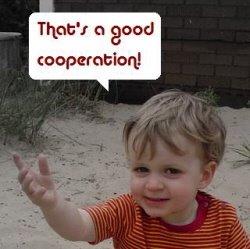
I vividly remember my own shock as I discovered, at the age of four and five, that girls could be mean. Yet my shyness was ingrained long before I knew about the petty exclusions of the little-girl world. Pie is the same way: she looks at other people warily. She may not know yet what they're capable of, but she knows enough to be suspicious. Bub, on the other hand, is hail-fellow-well-met. He never met a plumber he didn't like. Grocery-store clerks are his new best friends. He is supremely confident that the people he meets will be passionately interested in the fact that he just watched the movie Madagascar. When his overtures meet with a lukewarm response, he is undaunted. Pie, meanwhile, watches from the wings. She doesn't know yet what to watch for, but she's learning. Her instinct for distrust will, in due time, teach her the signs of rejection, disapproval, and dislike that will keep her mutely at the edge of the high-school cafeteria. She will avoid certain pitfalls that others overlook, but she will never know the blithe freedom of those extraverted peers whose innate trust in the human race preserves them in blissful ignorance.