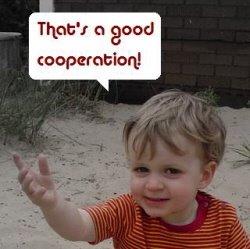
"I have to win!" Pie panted as we ran along the beach last weekend in an impromptu game of tag. "I have to win, or else I might ... lose!"
Winning and losing is a concept that dawns gradually for preschoolers, I find. Pie's first exposure to it was in our games of Dora Uno last summer. At first she was thrilled just to be playing with me, but gradually her expression started to turn sour whenever I happened to win. From there we built up some strategies - if you lose, I explained, just play again. Maybe you'll win next time. In recent months, Pie has become simultaneously more competitive and a slightly better loser: instead of sulking or refusing to play, she dives into the next round with a renewed determination to beat me.
Sore losing is like an allergic response - it doesn't flare up on one's first exposure, and each additional exposure prompts a more intense response. There is a stage in toddlerhood where games are pure activity; children are too young to understand the rules or even the object of the game, so instead of taking turns catching fish and then counting their catch to see who wins, they simply cooperate, arranging the fish into families and then taking everyone on a picnic.
Once children are able to play organized games, competitiveness begins to emerge, but it's still focused on process rather than the end result. Three-year-old soccer is a perfect demonstration of this principle. Not all the kids have grasped the concept yet: many of them are still wandering off to pick dandelions or enthusiastically kicking the ball into their own net. But even among the most competitive, the ones who consistently and skilfully score all the goals, there is no urge to keep score, no need to find out who won at the end of the game. By age five, though, the scorekeeping urge has begun to take over. "You guys are really good!" one of the parents said at Bub's last soccer game.
"Yeah," the goalie replied modestly, "the green team has all the best players."
One of the things I enjoy about Bub is his excellent sportsmanship. Sportsmanship is, perhaps, the wrong word, since it implies someone who is actually willing to participate rather than lying down in the middle of the field or gathering kids from the opposing team to show them the workings of his Ben Ten Omnitrix. But Bub has a genuine and disarming ability to rejoice in others' success. "You won!" he'll exclaim excitedly at the end of a game, adding as an afterthought, "I guess that means I lose!"
I was thus a bit surprised the other day when he was playing a game of roll-the-dice with Pie. It was Balderdash, actually, but without the cards or definitions, a simple game of moving pieces around the board to see who would reach the letter Z first. Bub won the first round and Pie, a veteran of numerous rounds of Dora Uno, cheerfully proposed a second game. When Pie won the second round, however, Bub melted down with startling rapidity and abandon.
Bub is a less experienced game-player than Pie, having until recently resisted activities that involve being told and/or shown what to do. He has yet to acquire the strategies that Pie has developed to cope with the agony of defeat. This was by no means his first experience of losing a game, however. I think what is new is his realization that the alternative to winning is losing, and that the person who loses is the loser.
All of this is developmentally normal and no cause for concern, but what I am struck by is the evidence of my own maternal naivete. In The Curious Incident of the Dog in the Night-time, the autistic narrator explains, "I do not tell lies. Mother used to say that this was because I was a good person. But it is not because I am a good person. It is because I can't tell lies."
It's a comical moment in the novel because Christopher's mother is such a cliche, crediting her son with virtues he does not really possess. This passage takes an attribute that sets Christopher apart from the norm and combines it with a maternal response that is nearly universal. What is more, readers almost universally share Christopher's mother's naivete. It doesn't matter how clearly Christopher explains his condition - readers are still willing to credit his innocence to him as righteousness.
It's something we do with our children as well, a biological imperative perhaps, an interpretive error with direct ties to the continuation of the species. We are charmed by the honesty of toddlers, even when technically we realize that they are not yet old enough to engage in deliberate deception. We delight in a two-year-old's capacity for living in the moment even though it merely reflects her inability to anticipate or conceptualize the future.
Bub has in some ways remained innocent longer than other children his age - longer, even, than Pie whose social awareness is acute. He hasn't learned yet to be jealous, to compare his possessions with those of his neighbour. He hasn't learned yet to temper his enthusiasm, to crack jokes at others' expense. He will learn these things, I know, just as he has already begun to learn the power of the words "I hate you" or "I don't want to be your friend." Like all other children, he has to learn to be worse before he can learn to be better. But in the meantime there is something shining and irresistible about his excitement when someone gives him candy - Bub hates candy, but he loves giving it to his sister. "Do you think Pie will like this?" he'll ask excitedly as he hurries over to give it to her, and I can't help admiring in him the purity of heart that so few adults are able to achieve.